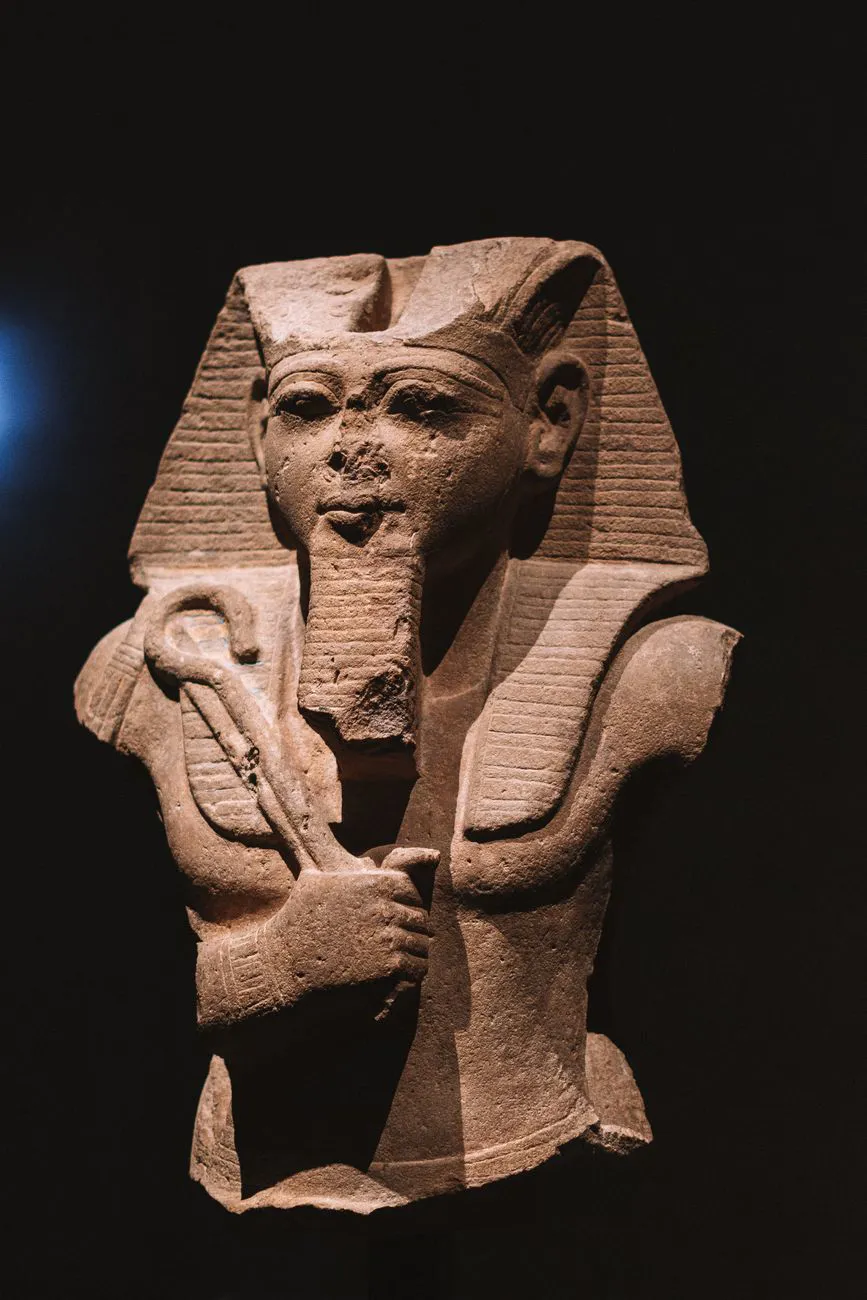
The remains of two monumental statues have been unearthed at Behbeit El Hagar in Egypt's Nile Delta after a resident discovered a stone bearing hieroglyphic inscriptions on his property. Khaled el-Shahat alerted antiquities officials, prompting the Ministry of Tourism and Antiquities to dispatch an excavation team. The village contains a temple for Isis, a goddess connected with healing and magic; the statues were found on the western side of the temple complex.
The larger sculpture depicts Ramesses II wearing the double crown, symbolizing his rule over Upper and Lower Egypt. Its surviving head measures approximately 5.2 feet, suggesting an original height of nearly 28 feet. A fragment of its back pillar preserves the king's Horus name, meaning "Strong Bull, Beloved of Right, Truth." The second statue, which also probably represents Ramesses II, measures about 7.9 feet and depicts a striped royal headcloth. Nearby, a pink granite block carries inscriptions naming him "King of Upper and Lower Egypt" and "Son of Ra," the sun god.
Ramesses II reigned for 66 years, from around 1279 to 1213 B.C., commissioning numerous building projects across an empire that reached modern-day Syria. In a 2017 paper, researchers described two architectural fragments bearing his name near the Isis temple and linked them to substantial construction there. Mahmoud Emam, a Cairo University Egyptologist involved in that earlier research but not the recent excavation, has warned that urban growth threatens the site and called for further archaeological investigation.