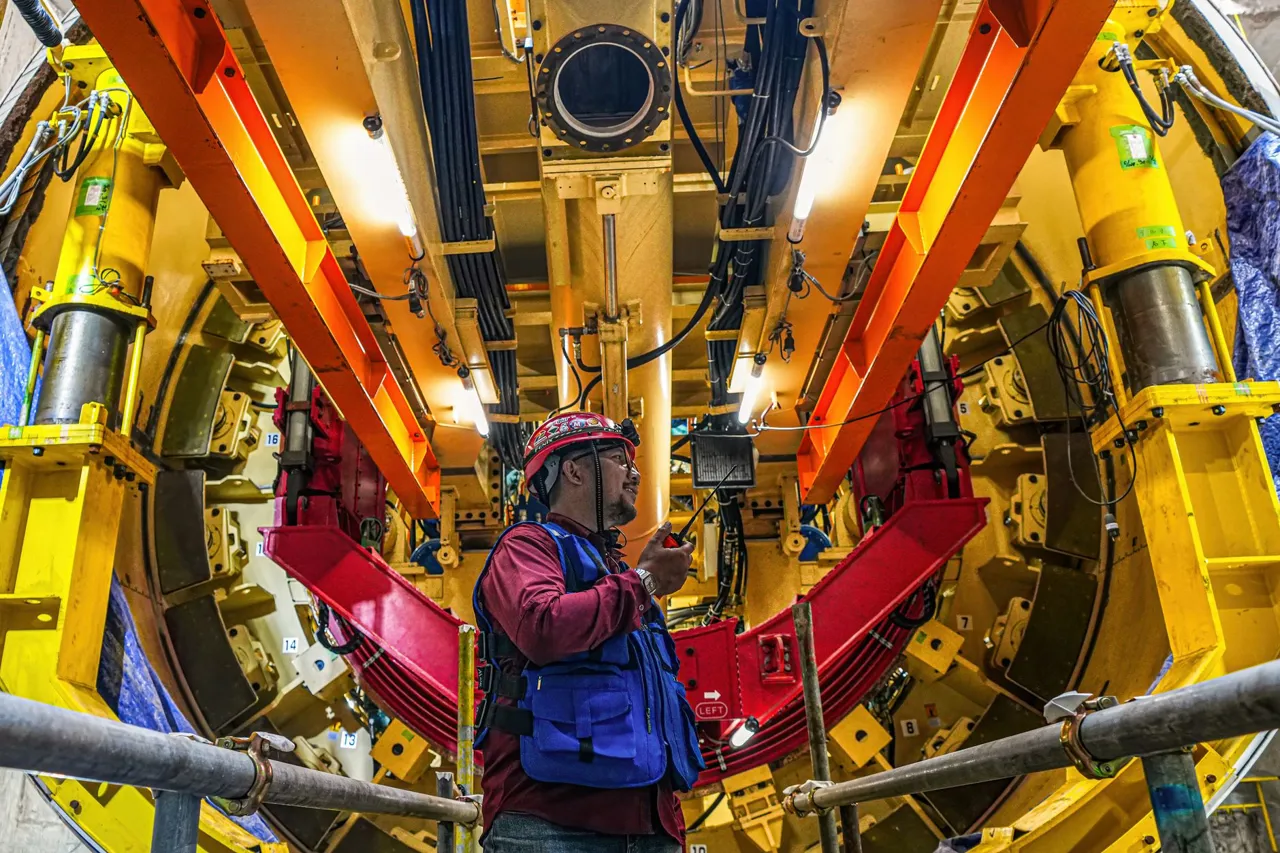
Engineers in China are remotely operating a 135-metre-long tunnel boring machine as it excavates part of the Jintang undersea railway tunnel between Ningbo and Zhoushan. Controlled from a surface centre roughly two miles away, Yongzhou has advanced more than 4,000 metres from Ningbo, completing about 83 per cent of its planned excavation. Personnel remain on board to supervise operations.
Cameras and sensors track cutting equipment and excavation conditions, while alerts sent to engineers’ smartphones flag problems such as unusual rotational force or changes in oil pressure. Having begun operating in May 2024, the machine is now approaching a section 93 metres beneath the seabed. Its 14.57-metre excavation diameter and 308 cutters were designed for the project’s challenging geology.
Nearly 70 per cent of its Ningbo-side route involves unfavourable ground, including hard rock, soft soil and mixed sections. Around 4,000 cutters have been replaced, with tougher stretches sometimes requiring replacement after only a few dozen centimetres of progress. For maintenance under high pressure, technicians can live in a pressurised chamber and work shifts for up to 28 days, reducing repeated compression and decompression. During the system’s first application in February, nine divers replaced 46 cutters over 22 days, approximately 75 metres beneath the seabed.
Yongzhou will eventually meet Dinghai, the machine advancing from Zhoushan, after which both will be dismantled inside the tunnel. The Jintang tunnel extends 16.18 kilometres, including an 11.21-kilometre section excavated using shield tunnelling machines. The Yongzhou Railway is expected to open in 2028, bringing rail services to Zhoushan and reducing the Ningbo–Zhoushan high-speed journey to 26 minutes.