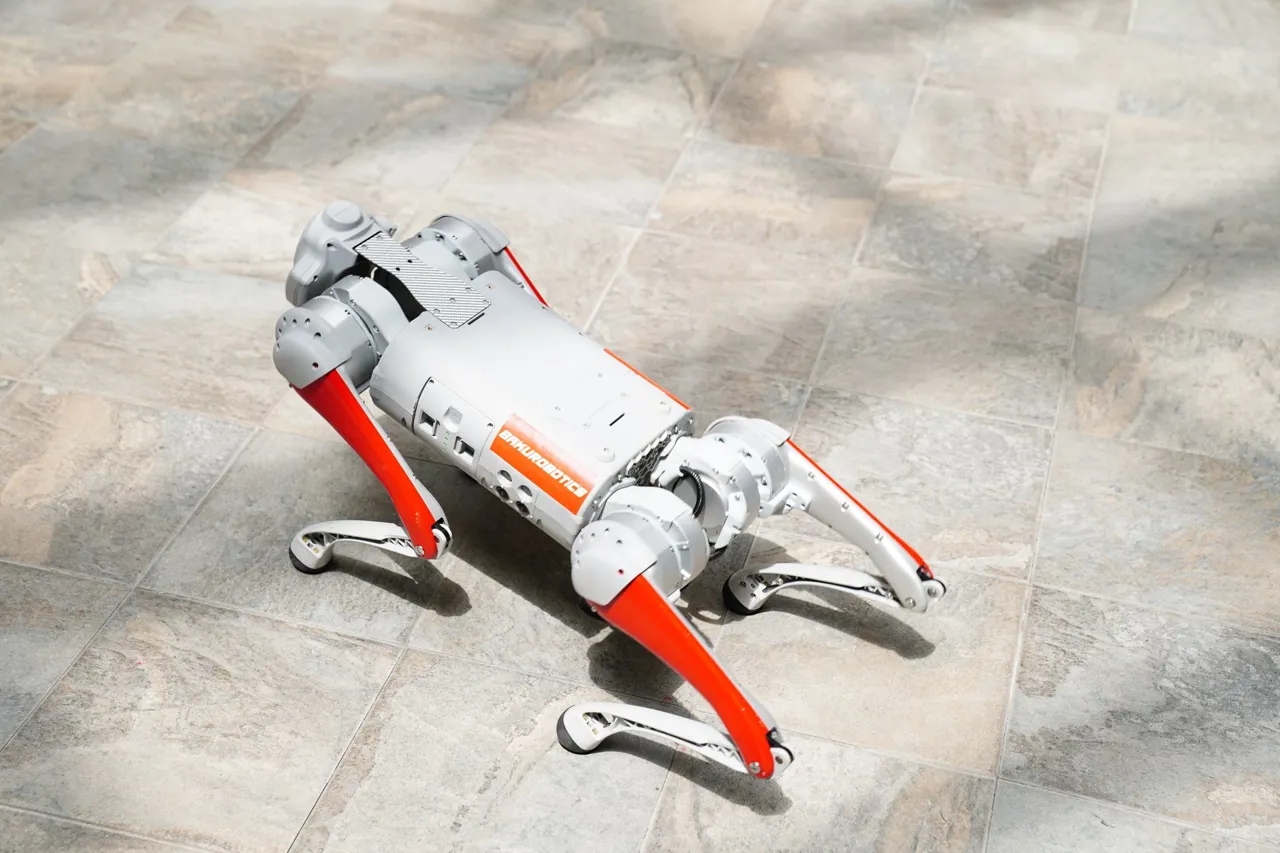
A four-legged ANYmal-D robot has independently solved a giant Rubik’s Cube using only its feet, according to researchers at ETH Zurich and NVIDIA. Across three completed trials on the physical robot, each solution required approximately 30 steps and eight to nine minutes. The system combines onboard perception with planning and coordinated movement, without additional arms or grippers.
To inspect every face, the robot walks around the freestanding cube and flips it while its depth camera identifies the coloured squares. A conventional solver calculates the solution, which a planner translates into repositioning, flips and layer turns. Camera observations update the cube’s location between movements, allowing the robot to adjust its position before the next action.
The movement skills include 90-degree flips towards or away from the robot. During a layer turn, one foot secures the cube while the other rotates its upper two layers; unintended rotation elsewhere would invalidate the remaining solution. These skills were trained through reinforcement learning in simulation, with virtual rewards for accurate foot placement, clean turns and balance. An initial stabilising force was gradually withdrawn.
Robustness tests involved slippery floors, cobblestones and moss-covered paving, alongside disturbances such as a rope pulling the robot’s leg or a stick pushing the cube away. The system recovered, and its flipping skills also transferred to a small, light box and a cylindrical container. In simulation, onboard depth sensing, controller memory and whole-body coordination improved performance.